
Spalding Projected Versus Actual Release
Projected, maximum, tentative, and actual release dates are not interchangeable. Georgia rules define the maximum release date as the date an inmate would leave Department custody after serving the full sentence, apart from a parole decision. The State Board of Pardons and Paroles uses a tentative parole month, or TPM, for the month in which final review may lead to a parole date. An actual release date records what occurred after the person left that custody system.
A pretrial detainee at the Spalding County Jail usually has no sentence-based release date. Release may depend on bond, a court order, dismissal, transfer, or later sentencing. A person serving a short county sentence may have an expected end based on the court commitment, but the jail record and court order remain the sources. A state inmate at Spalding County Correctional Institution follows GDC computation and possible Board review.
| Record term | What it means | Best source |
|---|---|---|
| County release date | Date the person leaves sheriff custody | Jail record or court |
| Maximum possible release date | Outer GDC sentence date without parole | GDC record |
| Tentative parole month | Planned Board final-review month | Parole Board |
| Actual release date | Recorded release or discharge event | Holding agency |
Find a Spalding Projected Date
Choose the search route from the custody type, not merely the county connected to the case. P2C is the current-custody channel for Spalding County Jail. It may show arrest, bond, court, and release-date fields in an inmate detail while available. The court record explains the order behind bond, time served, sentence completion, or transfer. The full local lookup sequence is also set out on the Spalding County released inmates page.
For a GDC inmate, use the direct GDC Offender Search. Match the GDC ID, name, offense, conviction county, and institution history. Read current status, actual release date, and maximum possible release date together. GDC warns that its online information may not be complete and directs written verification to Inmate Records and Information, P.O. Box 1529, Forsyth, GA 31029.
- Identify whether the person is in the county jail, a county correctional institution holding state inmates, or another GDC facility.
- For county custody, check P2C, then the court case and sheriff records for the controlling order.
- For state custody, search GDC and compare status, actual release, maximum release, sentence, and institution history.
- If parole is possible, check the Board's TPM lookup before release and parolee search after release.
- Verify any important date with the agency record rather than relying on one portal field.
Note: No GDC result does not prove a county-jail release because many local detainees never enter state custody.
Spalding GDC Date Fields
The GDC offender record carries several fields that answer different parts of a release-date question. Current status helps distinguish active custody from an inactive or released record. Actual release date becomes the key date when populated. Maximum possible release date is the sentence-based outer point. Most recent institution helps trace placement, but it does not prove the person remains there today. Sentence records and incarceration history explain the computation.
The Georgia rules in Subject 125-2-4 define sentence-computation terms including maximum release date and tentative parole month. A maximum date should not be described as the day someone will walk out. Parole, sentence credits, corrected jail credit, detainers, and new court action can change the practical outcome.
| Field | Use |
|---|---|
| Current status | Shows the custody or release state reported by GDC |
| Actual release date | Confirms a recorded GDC release when filled |
| Maximum possible release date | Shows the outer sentence-based date |
| Most recent institution | Supports custody history, not present placement by itself |
| Sentence history | Shows terms, offenses, and sentence relationships |
Georgia PIC Changes Spalding Dates
Georgia's Performance Incentive Credit, or PIC, is a distinctive part of state release-date computation. GDC describes PIC as an incentive reentry process for eligible offenders who make satisfactory progress in education, vocational work, treatment programs, work assignments, and good behavior. The program does not create one automatic deduction for every state inmate.
O.C.G.A. 42-5-101 authorizes work incentive credits for eligible felony prison terms other than life imprisonment. Credits may reflect academic or vocational attainment, satisfactory work, and conduct. They are reported to the Parole Board and may support advancing an established tentative parole release date.
The Board explains that when parole is tentatively scheduled, it may set both a TPM and a PIC date. The gap is the maximum possible advance for good conduct. Poor institutional conduct can delay the TPM or result in denial. The official GDC page illustrates this state-specific link. Review the GDC PIC program before interpreting an advanced date.
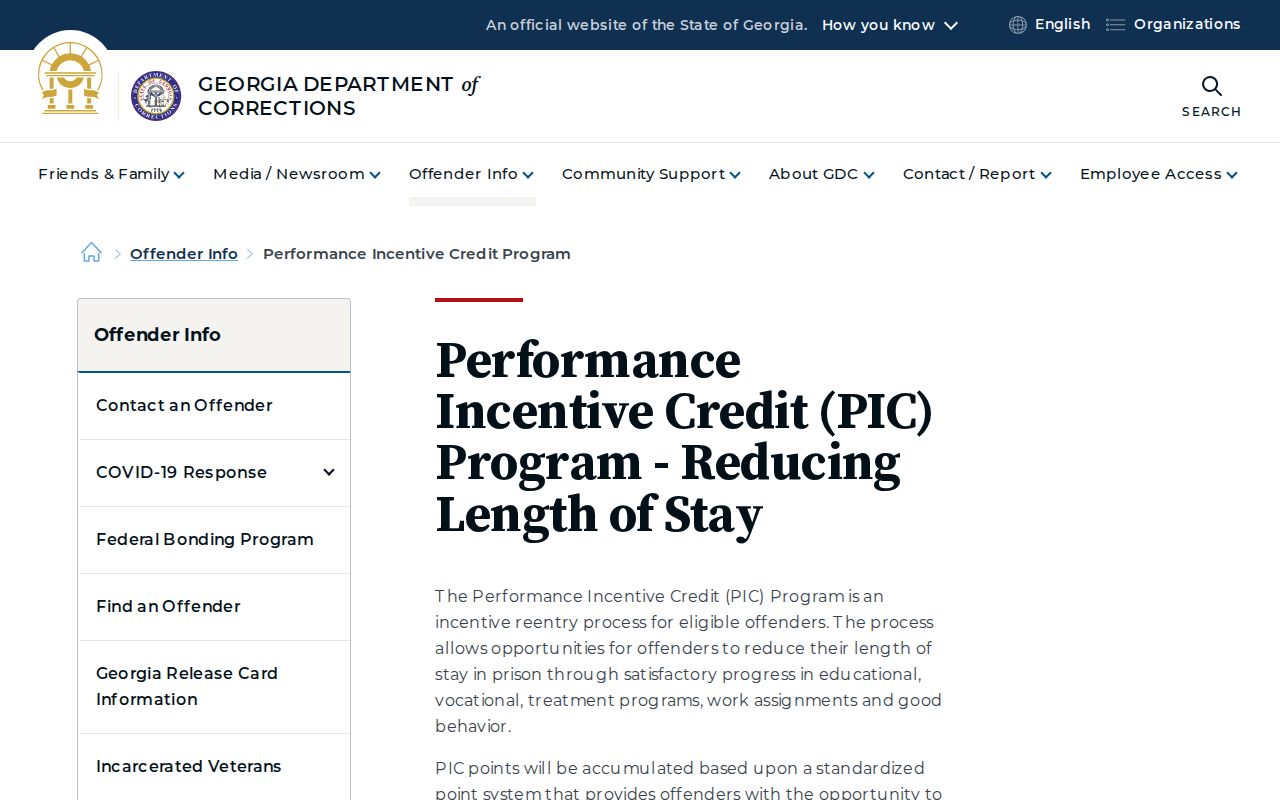
The captured PIC material connects program progress with parole timing, but it does not replace a current GDC or Board result for a named person.
Spalding TPM and Parole Timing
General parole eligibility and a TPM are separate. O.C.G.A. 42-9-45 generally provides consideration after nine months or one-third of the sentence, whichever is greater, unless another law controls. Aggregate sentences of at least 21 years generally use a seven-year point, subject to exceptions. No written parole application is normally required for initial consideration.
The Inmate TPM Lookup can be searched by inmate number, GDC ID, or personal data. The Board may set a future month or deny parole. Even after a TPM appears, misconduct, unfinished requirements, a detainer, or another case change can postpone or cancel the plan. The Board may reconsider before release.
Serious violent felony sentences face stricter limits. O.C.G.A. 17-10-6.1 limits parole, earned time, early release, work release, leave, and other reductions for covered sentences, with narrow statutory details. There is no universal “85 percent” rule to apply to every Georgia sentence in this research. The offense and governing statute must be read.
Why Spalding Release Dates Move
A date can change because sentence administration is not static. Court credit may be corrected. Concurrent sentences run together, while consecutive sentences run one after another. A detainer can turn a county or GDC release into transfer to another authority. The Board may advance, delay, or deny parole. Program progress and discipline can affect parole review.
| Factor | Possible effect | Confirm with |
|---|---|---|
| Jail or sentence credit correction | Moves the computed end date | Court and records office |
| Consecutive or concurrent terms | Changes total time calculation | Sentence record and GDC |
| Detainer or hold | Causes transfer instead of community release | Holding and receiving agencies |
| TPM decision | Advances, delays, or denies parole | Parole Board |
| PIC or discipline | Affects possible TPM movement | GDC and Board |
| New order or warrant | Interrupts the expected path | Court and issuing agency |
For a Spalding detainee, a missing P2C record is only a clue. The person may be released, transferred, not fully booked, or listed differently. For a state inmate, an old maximum date can remain visible even when the operative parole path has changed.
Confirm Spalding Actual Release
When release is near, Georgia VINE can provide a custody-status notification for participating agencies. Register before the event when possible. A VINE alert is evidence of a custody change, but it may not explain bond, discharge, parole, or transfer. The detailed registration process is on the VINELink Check page.
After the expected date, return to the source system. For the county jail, use P2C, the sheriff record, and the court order. For state custody, read GDC current status and actual release date, then use Parolee Search if the person left on parole. If a detainer applies, check the next custody authority. This last check prevents a projected release from being mistaken for release to the community.
Note: A release from one agency can be a transfer to another, so verify the next custody status before treating the person as free.
Spalding County Sentence Records
When two date fields conflict, request the record that supports the computation. A county case may require the sentencing order, later modification, jail-credit entry, bond order, or commitment document. A GDC case may require written verification of status, sentence history, and the recorded actual release. Ask for existing records and give the person's full name, GDC ID or case number when known, conviction county, and the date range at issue.
Georgia's open-records process does not require an agency to create a new forecast. A custodian may provide the records already maintained and redact material covered by an exception. That is why a request for “the projected date” can be less useful than a request for the current sentence record, maximum possible release date, actual release date if present, and any public order that changed the calculation. The source documents reveal which date was official at each stage.
For court questions, identify the exact Spalding case before contacting the clerk. For GDC questions, use the written verification address listed with Find an Offender. A clear request reduces the chance that county jail time, state prison time, and parole review will be mixed into one unsupported estimate.