
Georgia DOC Release Records
GDC tracks people sentenced to Georgia state custody. That includes state inmates held at GDC prisons and those placed at county correctional institutions under state rules, such as Spalding County Correctional Institution. A state offender may move among facilities without leaving GDC custody. The current status, actual release date, most recent institution, incarceration history, and sentence data must be read together.
A release may lead to parole, complete discharge, or another authority. Parole ends confinement but leaves the person under a state sentence and field supervision. Discharge means the applicable custody or supervision obligation has ended. A move from one institution to another is neither event. GDC supplies the central state record, while the Parole Board and Department of Community Supervision explain parole and post-release supervision.
| Record field | What it establishes |
|---|---|
| Current status | Whether the record reflects active, inactive, parole, or another available status |
| Actual release date | The recorded state release or discharge date when populated |
| Maximum possible release date | The outer sentence date, apart from parole decisions |
| Most recent institution | Placement history, which is not release proof by itself |
| Sentence history | Conviction county, offense, term, and related custody context |
Run a Georgia DOC Search
Open the official GDC Offender Search. Use a GDC identification number when known. With a name search, compare physical description, aliases, date information, major offense, conviction county, and sentence history before accepting a match. Similar names can produce the wrong record, and an old institution entry may remain in a person’s history.
- Search by GDC ID or full name.
- Confirm identity with several record fields.
- Read current status before relying on a date.
- Compare actual and maximum release dates.
- Review institution and incarceration history for transfers.
- Check parole sources when the status or case calls for it.
If GDC shows active custody, the maximum date and tentative parole month are planning fields. They do not prove release. If the record shows an actual date with an inactive, released, or parole status, that combination is stronger evidence that confinement ended. GDC warns that its public data is not warranted complete or accurate, so written verification remains available.
Georgia DOC Search Screen
The GDC Find an Offender page introduces the search, states its accuracy limits, and warns that an offender photograph may display automatically. That warning matters when searching in a shared or public setting. The image below records the official GDC entry page used for a Spalding-connected state-inmate check.
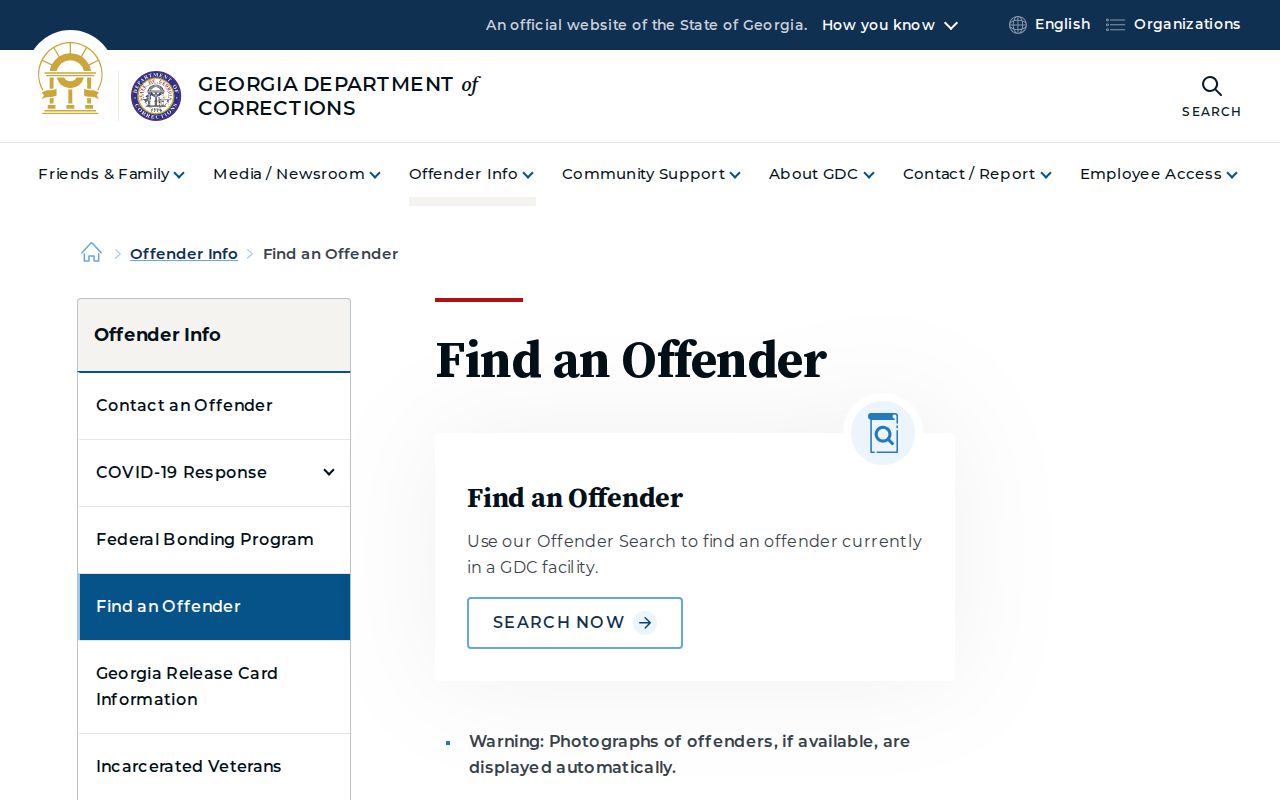
The screen is an entry point, not release proof. Open the matching offender record and compare status, dates, identity fields, and sentence history. A photo can help distinguish people, but it does not establish whether the person remains confined, transferred, paroled, or discharged.
Georgia DOC Date Meanings
Georgia correctional rules separate sentence dates from actual release. A sentence begin date accounts for the start of the sentence, credited jail time where allowed, and special instructions. The sentence end framework reflects the maximum term and adjustments. The maximum release date is the date the person would leave DOC custody after serving the whole term, excluding parole decisions.
A tentative parole month, or TPM, is set through the State Board of Pardons and Paroles. It is a planned month for final parole review and possible placement, not a guarantee. The Board may condition the outcome on conduct or required programs and can reconsider before release. Some sentences have different eligibility or reduction limits under Georgia law.
- Actual release date
- The recorded date confinement or the listed GDC status ended.
- Maximum release date
- The full-term state custody date without a parole decision.
- TPM
- A tentative parole month subject to review and change.
- Discharge
- Completion of the applicable state custody or supervision obligation.
Georgia PIC Release Context
GDC’s Performance Incentive Credit program links eligible participation and a reentry case plan to sentence-credit decisions. The official PIC page supplies background for why a projected date can differ from a simple sentence-end calculation. It does not replace the offender record or promise that a named person will receive a specific release date.
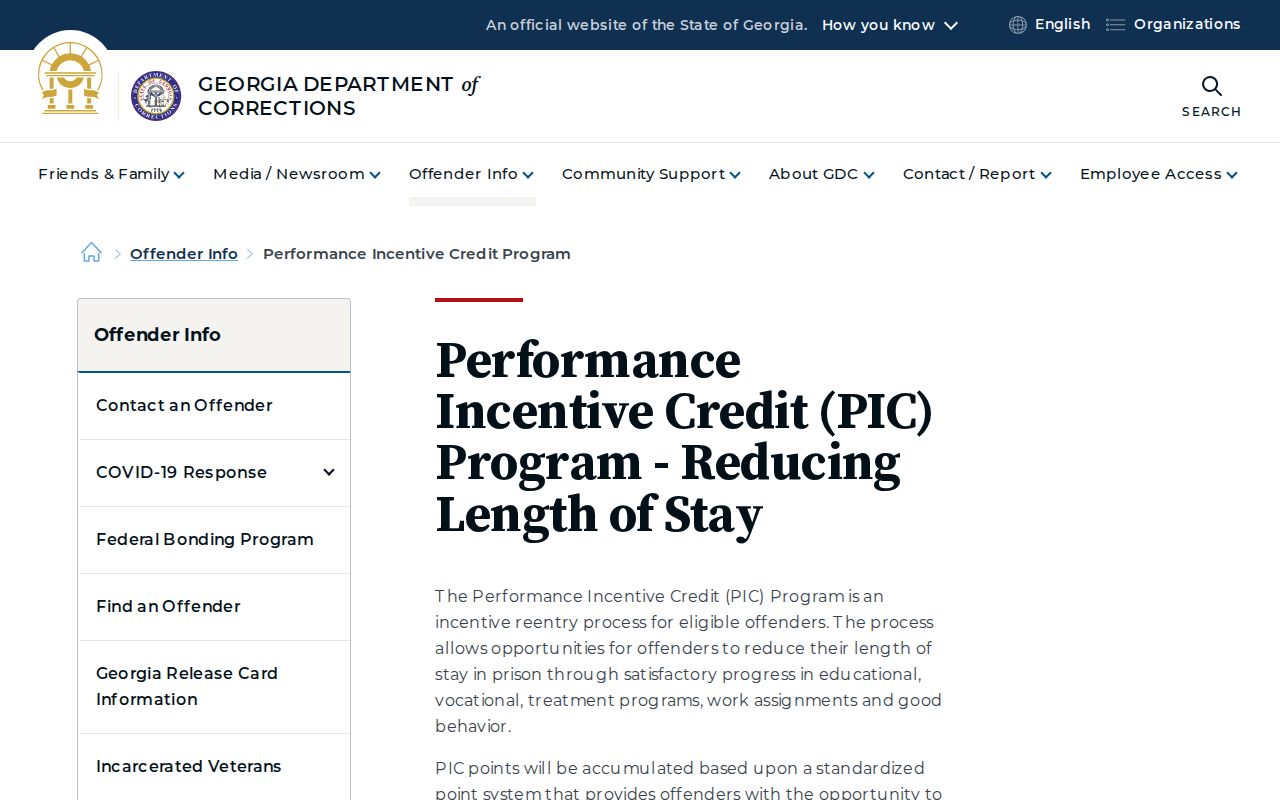
Credits, loss of credits, sentence changes, detainers, parole action, and case-specific rules can alter the practical date. Serious violent felony sentences have statutory limits that may restrict reduction. Use the current offender fields and the responsible agency’s record instead of calculating a release date from general policy alone.
Georgia DOC Direct Query
The direct state offender query is the working search route. The captured screen below is tied to that official URL and helps identify the state tool rather than the nearby sheriff P2C system.
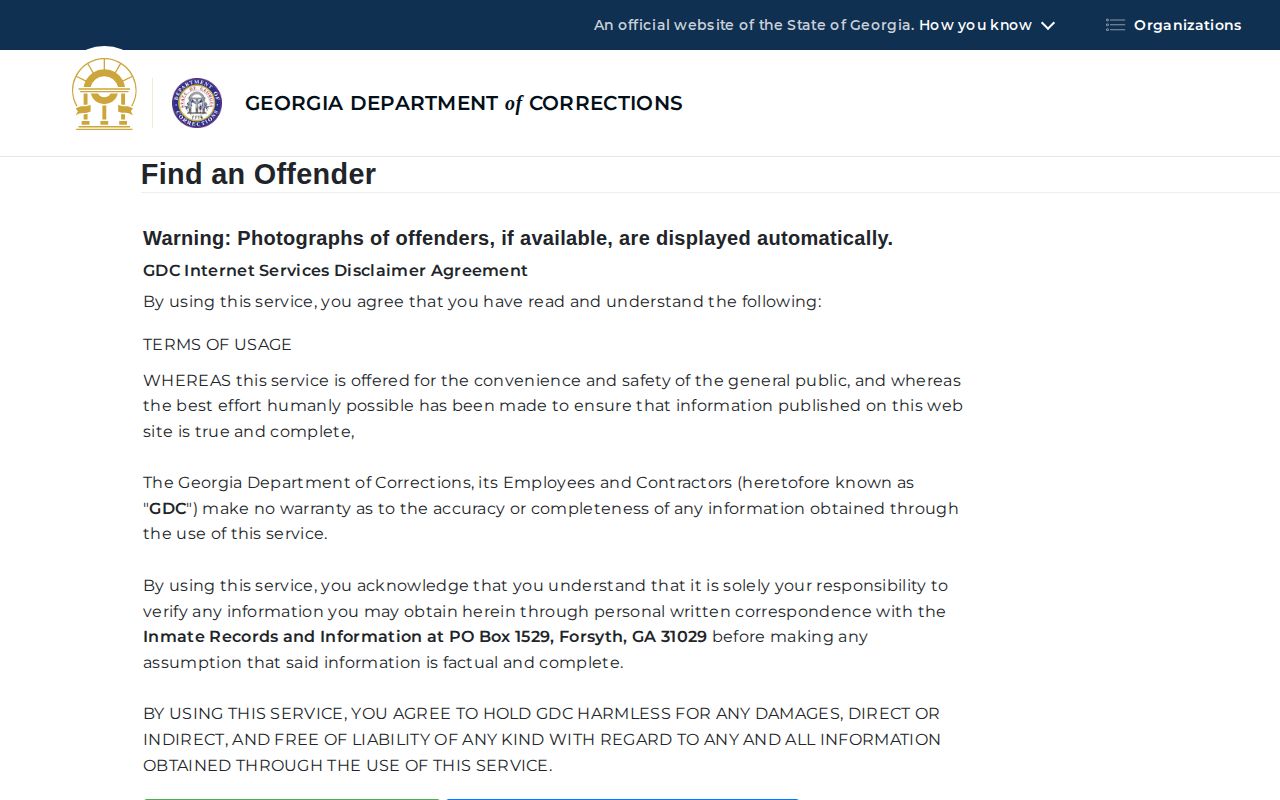
For a former Spalding County Correctional Institution placement, review the institution history as well as current status. For someone transferred from Spalding County Jail after a state sentence, a GDC record may begin after the county roster entry ends. Conversely, no GDC result is expected for many people who bonded out or completed a local jail matter without entering state custody.
Spalding State Facility History
Spalding County Correctional Institution has a local history that explains why its inmates belong in a statewide GDC search. The county says the original operation began as a work camp in 1952 and that the current Justice Boulevard location was built in 2001. It supports local-government work details while holding state inmates under county governance and GDC operating rules.
The nearby sheriff’s jail has its own current-custody inquiry. SCCI does not. Someone can be physically held in Spalding County yet remain part of the state correctional system, so the operator and sentence status matter more than the county address. GDC lists SCCI as an adult male felon, medium-security location. Use institution history to confirm the placement, then use status and release fields to decide whether state custody ended.
Georgia DOC Parole Verification
The Parole Board’s Inmate TPM Lookup is the pre-release planning tool. Its Parolee Search is the better source after a person is released on parole. Search results can be compared by name, case number, UPI number, GDC ID, ZIP code, and available identity details. A parole match confirms a supervision path, not a full sentence discharge.
DCS handles field supervision for felony parolees, probationers, reprieve cases, and split sentences. The Griffin field office serves Spalding County from 700 Legacy Park Drive in Barnesville, Monday through Friday from 8:00 a.m. to 4:30 p.m., at (770) 358-5047. That office helps with supervision navigation. It is not the archive for every GDC release record.
Parole and probation are not interchangeable. Parole follows release from confinement on a prison sentence. Probation is imposed by a court, often instead of or after a period of confinement. A person can be out of prison while still subject to state supervision, so the phrase “released” does not always mean the sentence has fully ended.
Georgia DOC Records Contact
GDC tells users who need formal verification to write to Inmate Records and Information. Give the full name, GDC ID, useful date range, and the exact existing release, discharge, sentence, or incarceration record sought. A specific request reduces identity errors and distinguishes a release record from a general question about the person.
GDC Inmate Records and InformationP.O. Box 1529
Forsyth, GA 31029
Inmate concerns: (404) 656-4661
GDC main mailing location: 300 Patrol Road, Forsyth, GA 31029
GDC also accepts open-records requests online. The research records a three-business-day initial response window, ten cents per non-medical copy, and possible search or redaction time billed at the lowest qualified employee’s hourly rate. Exceptions may apply, and the agency need not create a new record. Ask for a defined record that already exists.
The Spalding County release search is the better starting point when the custody type is unknown. It routes a county detainee to P2C and court records, a state inmate to GDC, and a federal or immigration transfer to the appropriate federal system.
Georgia DOC Detainer Transfers
An actual release from GDC may lead directly to another authority. A detainer is a request or legal basis for another jurisdiction to assume custody. New charges, another sentence, federal process, or immigration process can prevent a direct return to the community. The GDC release field marks the state event, while the receiving system answers what happened next.
Spalding’s sheriff publishes quarterly immigration reports under Georgia HB 1105, which provides a distinctive local detainer layer. Those reports concern the detention center and do not replace the state-offender record. Use them only when a documented Spalding jail event is part of the chain. For federal post-conviction custody use BOP; for immigration custody use ICE; and for much federal pretrial transport, public details may depend on federal court and USMS records.
Public Record Search
Sponsored Results