
Spalding Parole Versus Probation
Parole and probation can both place a released Spalding County person under rules in the community, but the legal source differs. The Georgia State Board of Pardons and Paroles decides whether an eligible state prisoner will leave confinement on parole. The Georgia Department of Community Supervision, or DCS, then provides field supervision. Probation begins with a Georgia court. A judge may impose a probated sentence, or a split sentence with confinement followed by probation. DCS also supervises those felony cases.
A person who posts bond at the Spalding County Jail is released while the criminal case continues. Bond does not turn into parole. Nor does it prove that probation exists. The court docket must show a probation sentence. A person leaving Spalding County Correctional Institution or another GDC facility may be paroled, discharged with no parole, or moved under another authority. Those paths call for different records.
| Point | Parole | Probation |
|---|---|---|
| Who orders it | State Board of Pardons and Paroles | Sentencing court |
| What comes first | Part of a state prison term | A court sentence, sometimes after jail or prison |
| Local field agency | DCS | DCS for felony supervision |
| Best record | Parolee Search and Board records | Court docket and DCS contact |
- Parole
- Conditional release from a state prison sentence before the sentence fully expires.
- Probation
- A court-ordered sentence served under rules in the community.
- Discharge
- The formal end of a sentence or supervision term.
- Split sentence
- A sentence combining confinement with a later period of probation.
Verify Spalding Post-Release Supervision
Begin with identity and custody type. A common name is not enough. Compare the person's full name with a GDC ID, case number, birth information when shown, offense, and court. The Parole Board's public Parolee Search accepts first name, last name, race, case number, UPI number, GDC ID number, or ZIP Code. Partial terms are allowed. That tool is the best public starting point for someone already released on parole.
Probation takes a different route. Search the Spalding court docket for the sentencing entry, because the judge creates probation. DCS confirms the field office and provides supervision navigation, but it is not a substitute for the sentence record. The full county release and court search path is available on the Spalding County released inmate search.
- Decide whether the person left the county jail, a GDC prison, or another custody system.
- For possible parole, search the Board's parolee database and match more than the name.
- For possible probation, find the Spalding court case and read the sentence or revocation order.
- Use the DCS field-office contact to confirm which office serves the case and how public verification is handled.
- If records conflict, request the source record from the court, Board, DCS, or GDC.
Spalding Parole Timing Records
Before a state inmate is released, the Board's Tentative Parole Month explanation and TPM lookup may show the parole process. A tentative parole month, or TPM, is the month in which final review is planned. It is not a fixed release date. The Board may require good conduct or program completion and may change an earlier decision before release.
The lookup accepts a six-digit inmate number, GDC ID, or personal data. A result may show that a TPM has been set or that parole was denied. Once the person is actually in the community on parole, switch to the parolee database. That sequence keeps a planned event separate from a released-person supervision record.
The official TPM explanation shows why the parole date needs careful reading. View the State Board's TPM explanation before treating a month as final.
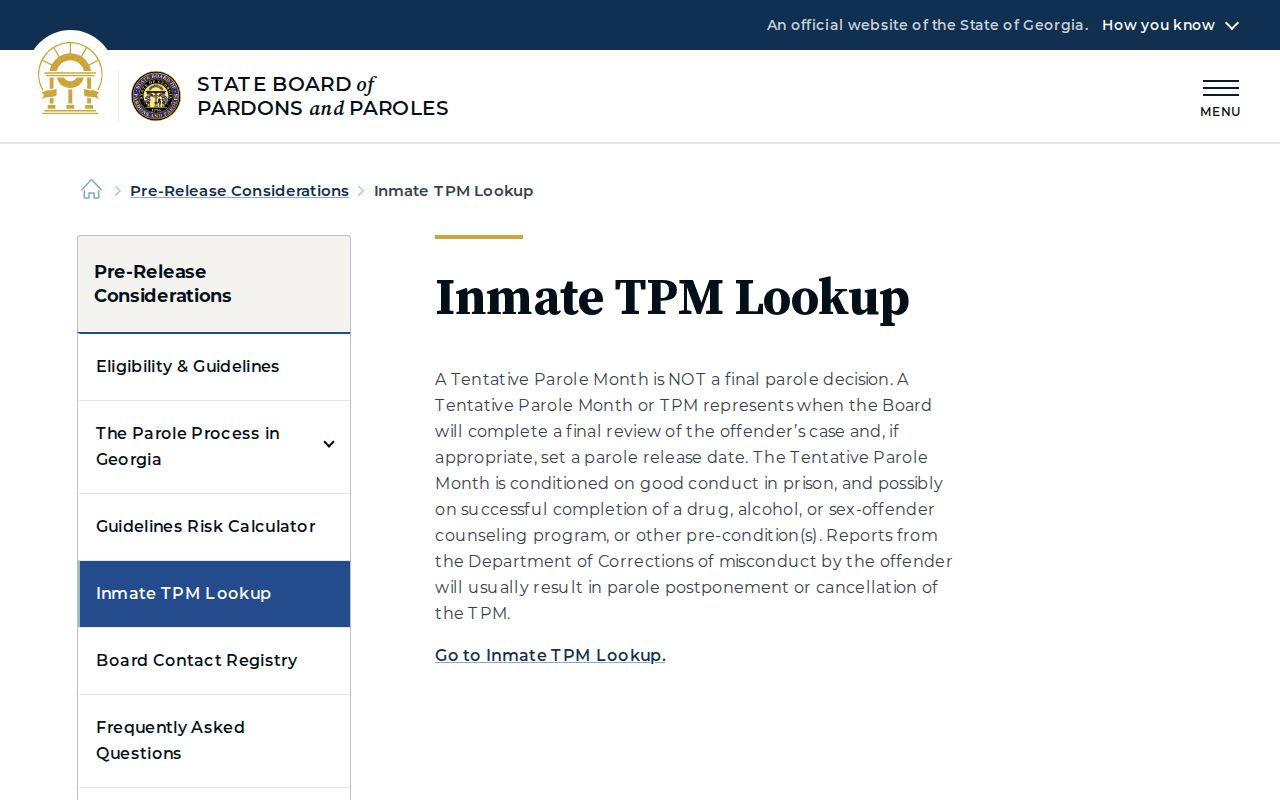
The captured page places the TPM in the Board's final-review process, which is different from an actual release date or a DCS supervision record.
Georgia law also shapes eligibility. O.C.G.A. 42-9-45 generally provides automatic parole consideration without a formal application, subject to sentence length and other laws. Certain serious violent felony sentences face much stricter limits under O.C.G.A. 17-10-6.1. Eligibility does not equal approval.
Spalding Supervision Office Contact
The DCS Griffin field office serves Spalding as well as Fayette, the Griffin Circuit, Pike, and Upson. It is the local field layer for parolees, felony probationers, reprieve cases, and split sentences. Staff can route supervision questions, but the office is not a full public archive of county jail releases or court files.
700 Legacy Park Dr
Barnesville, GA 30204
(770) 358-5047
Monday-Friday, 8:00 a.m.-4:30 p.m.
The official office listing gives the service area and contact details shown here. Open the DCS Griffin office listing to check current agency information.
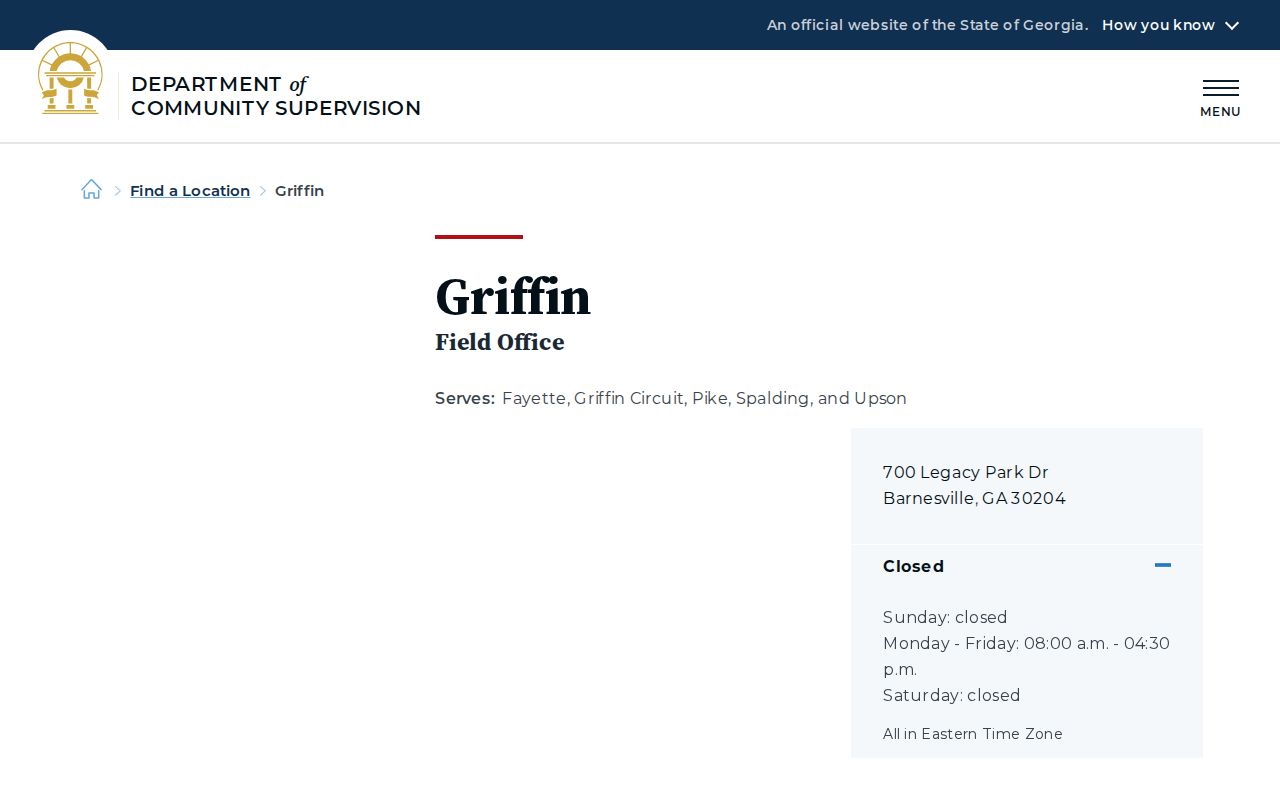
The listing confirms that Spalding County supervision is served through the Griffin field office even though its street address is in Barnesville.
For an underlying felony probation sentence, use the court docket as well. For an actual release or discharge date, use the jail, GDC, or court record that created it. DCS is the best local source for present field-supervision navigation.
Spalding Warrants After Release
A new warrant or wanted entry can appear after a person leaves custody. Causes may include a failure to appear, an alleged probation violation, or another warrant. Spalding's official P2C system includes a Wanted List with fields such as name, charge, paper type, agency, issue date, and wanted identifier. This is Angle J from the local research: the wanted channel shares the sheriff's system with Inmate Inquiry but answers a different question.
A wanted-list match does not prove when the person was first released. It shows a present warrant or wanted record. Confirm identity, then check the court case or supervising agency for the order behind the entry. An absconder is a supervised person alleged to have stopped reporting or left supervision without permission. It is a status requiring source confirmation, not a synonym for every person with a warrant.
The official screen provides the county context. Check the Spalding P2C Wanted List for the current record.
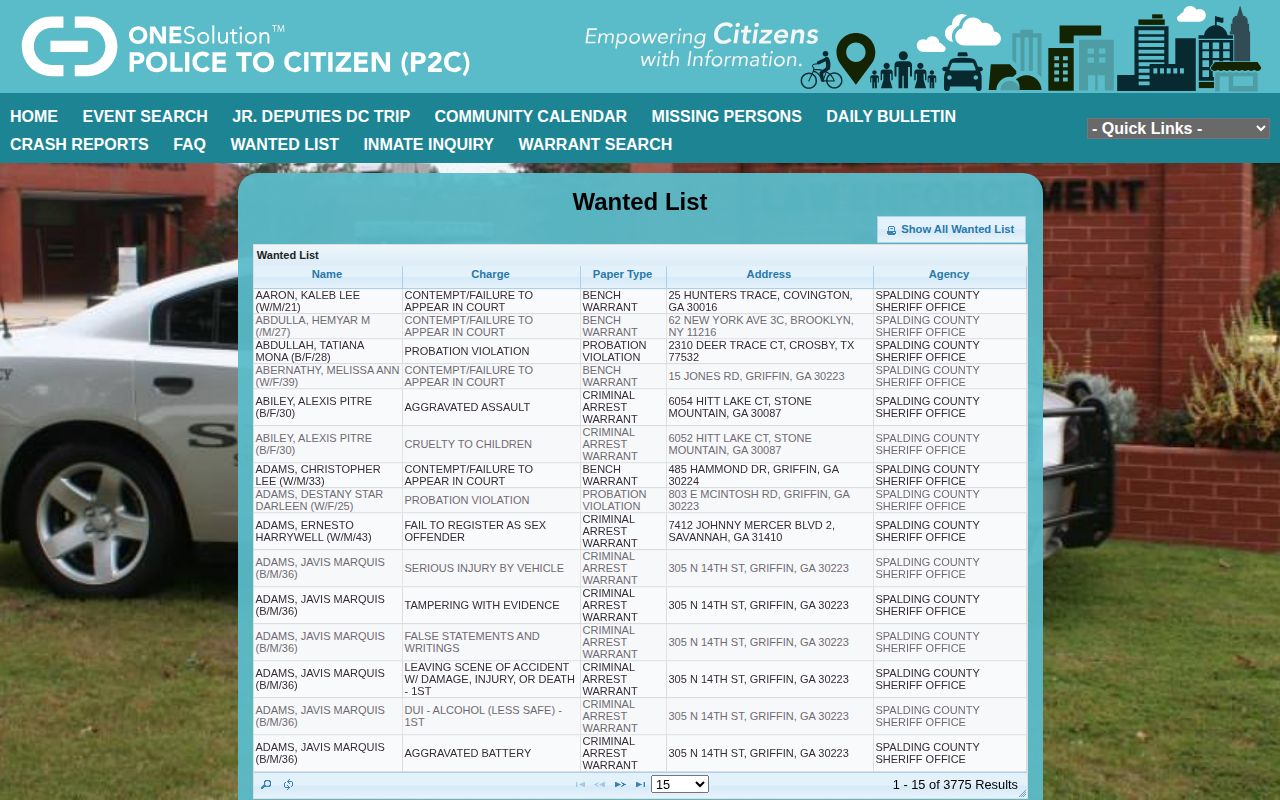
The image shows the separate wanted-list channel, reinforcing that warrant status and original release status must not be merged.
Note: Portal updates can lag, so a court or agency record should resolve a time-sensitive conflict.
Spalding Reentry After Supervision
Angle G adds a local path beyond status lookup. The Spalding County Reentry Program describes a structured route toward stability, accountability, and renewed purpose. Its listed telephone is 678-603-1090. This resource is for navigation after release. It does not determine whether parole or probation exists and should not be used in place of a Board, DCS, or court record.
Conditions of supervision vary by order. At a high level, they may cover reporting, lawful conduct, approved residence or travel, payments ordered by a court, and participation in required services. A claimed violation can lead to review, a warrant, or a revocation proceeding. The court controls probation revocation. Parole action belongs to the Parole Board, with DCS supplying field information.
Property After Spalding Release
Angle H answers a practical concern that often follows a jail release. The sheriff's property policy says phones, keys, wallets, jewelry, and similar items held in personal property are returned upon release. Remaining funds in the inmate account are also returned at release. Those facts can matter when a person needs identification, keys, phone access, or funds to report to supervision.
This property process belongs to the Spalding County Jail. It is not the rule for every GDC institution. If property is missing after a state-prison release, contact the releasing institution. If the concern is a supervision report date or location, call DCS rather than assuming a property delay changes the legal duty to report.
Ending Spalding County Supervision
Supervision ends through an official discharge, sentence expiration, or other authorized order. Leaving jail does not end a court sentence. Finishing a reporting period also should not be assumed without the source record. Parole certificates and discharge actions belong to the Board's record system, while probation completion is tied to the sentencing court and DCS case administration.
Georgia Archives retention information identifies clemency actions such as parole certificates and discharge orders as permanent Parole Board records. Some Board files are confidential under state law, so the public parolee search may be the easiest first check. If formal proof is needed, ask the agency for the available discharge record and identify the person, case, and approximate end date. Note: A final source record is stronger than an old portal result when confirming that supervision has ended.