
Understanding Spalding County Releases
A release means one agency's legal custody has ended. It does not always mean the person walked into the community. Spalding County Jail may release someone on bond, after time served, by court order, to probation, or to another custodian. A transfer to the Georgia Department of Corrections, U.S. Marshals Service, or Immigration and Customs Enforcement ends the local jail stay but starts or continues custody elsewhere. That distinction controls which record can confirm what happened.
The Sheriff To Citizen system, called P2C, is a current-custody tool. Its Inmate Inquiry shows people presently listed at the jail. A person normally drops from that grid after release. The lasting evidence is the sheriff's booking and release record, the bond or court disposition, or a record in the next custody system. For a state inmate housed at the separate Spalding County Correctional Institution, the Georgia Department of Corrections record is the right starting point.
- Release
- The end of custody by a particular agency.
- Discharge
- The end of a sentence or supervision obligation.
- Time served
- Release after credited custody satisfies the ordered jail term.
- Detainer
- A request or legal hold that can send a person to another agency.
Spalding County Release Paths
The release reason matters more than a blank roster result. Bond permits release while a case continues. A court can also dismiss a charge, modify a sentence, credit time served, order probation, or direct a transfer. Sentenced state inmates may later be paroled or discharged through GDC. Federal and immigration holds create different trails.
| Release path | What it means | Best next record |
|---|---|---|
| Bond | County custody ends while the case remains open | Sheriff release entry and court docket |
| Time served or court order | The jail acts on sentence credit or a judge's direction | Release record and signed court entry |
| Probation | A court orders community supervision | Court disposition and DCS confirmation |
| Parole or GDC discharge | State prison custody changes or ends | GDC and Parole Board records |
| Transfer or detainer | Local custody ends but another agency receives the person | Transfer entry and receiving-agency locator |
Spalding's bond rules add useful local context. The Sheriff's bonding page describes cash, property, and professional bonds. It states that a $20 fee is collected for each bond written. Property bonds require photo identification, a deed, a current tax statement, enough equity, and sheriff approval. Property outside Spalding County must first be processed by the sheriff where that property lies, then delivered to the jail within one day of the bond date.
Spalding County Release Record Fields
A release record connects the end of custody to the original booking. P2C detail pages can expose a release date while the detail remains available, but the current grid is not a permanent archive. Ask for the existing booking and release material when a formal record is needed. The following fields help distinguish a true release from a transfer or data delay.
| Field | What it shows |
|---|---|
| Full name and booking ID | The identity and specific jail admission |
| Arrest and booking dates | When local custody began |
| Charges and booking agency | Why and by whom the person was booked |
| Bond and court date | Possible conditions and next case event |
| Release date and time | When Spalding custody ended |
| Release reason | Bond, court order, time served, transfer, or another recorded basis |
| Receiving authority | The next custodian when release was a transfer |
A booking photo is not proof of release. Nor is a charge list. The release date, release reason, court order, bond record, or new custody status supplies that proof. Identity should be matched with a date of birth, booking number, or case number when names are common.
Request Spalding County Release Records
The county's JustFOIA public portal is the practical request route. Georgia agencies need not create a custom list that does not exist, so request existing records rather than asking staff to compile a new report. A focused request is easier to locate and less likely to produce avoidable search costs.
- Give the person's full name and date of birth, if known.
- State the approximate booking and release dates.
- Name the records sought, such as the booking entry, release date and time, release reason, bond paperwork, transfer record, or booking photograph.
- Submit through JustFOIA and retain the tracking details.
- Review the response for redactions, fee estimates, or a request for clarification.
O.C.G.A. 50-18-71 permits search, retrieval, and redaction charges based on the lowest-paid qualified employee, after the first quarter hour at no charge. Letter or legal copies may cost up to $0.10 per page. The law requires timely access, but an office may first provide a response, estimated cost, or production schedule. Sheriff administration processes local open-records requests. GDC uses its own open-records portal for state records and lists a three-business-day initial response period.
The successful capture of the Spalding County request portal shows the official entry point used for county records.
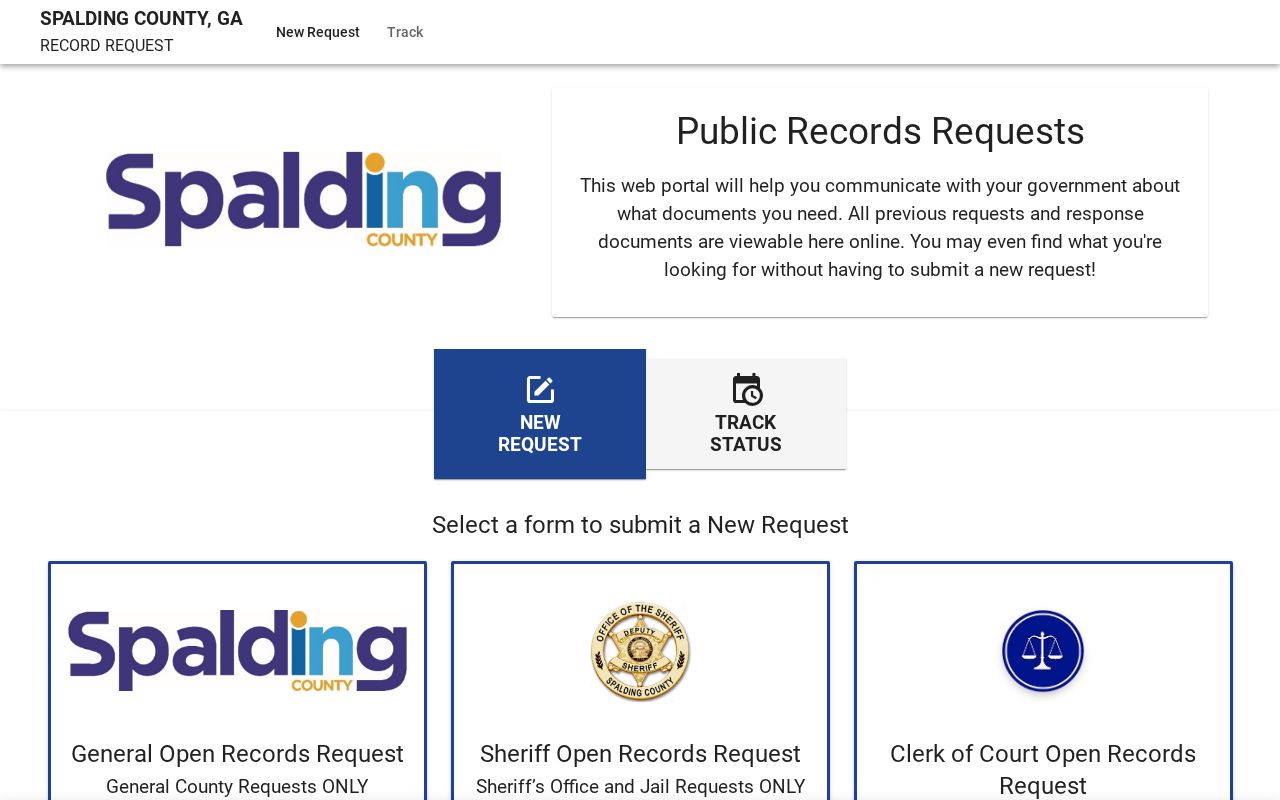
That portal is for records held by the county; GDC, the Parole Board, DCS, and federal agencies keep separate files.
Spalding Release Records and Restrictions
The Georgia Open Records Act covers documents, photographs, computer data, and other material prepared, held, or received by an agency. Access still has limits. Personal identifiers, medical material, active investigative information, security records, juvenile files, and restricted or sealed information can be withheld or redacted. The office must produce records that exist, not answer research questions or make a new summary.
Georgia record restriction is not physical destruction. The GBI restriction guidance explains that arrests after July 1, 2013 generally route through the prosecutor, while older arrests use the arresting agency process. Restricted material remains available to courts and criminal-justice agencies. Juvenile proceedings and law-enforcement files follow separate access and sealing rules. These limits explain why an old release may be absent from a public portal even though an authorized office retains a record.
Property After Spalding County Release
The Sheriff's property instructions describe what happens to clothing, keys, phones, wallets, jewelry, and inmate-account funds. Designated clothing pickup must occur within ten days after intake. Personal items stay in the property unit and are returned at release. The person may call someone to bring clothes when leaving custody, and remaining account funds are returned then.
A released person has 30 days to return for additional property. That local deadline matters when keys, identification, medicine-related documents, or a phone are needed to travel or reconnect. The property record also helps establish that a release process occurred, but it does not replace the formal release entry.
Find Released Spalding County Inmates
Begin with the system tied to the custody type. P2C can confirm that a person is still listed at the county jail, but Spalding County publishes no separate official 24-hour or 72-hour release feed. A missing name is only a clue. P2C updates at scheduled times and can lag until booking is complete.
- Search the P2C Inmate Inquiry and match the name, age, arrest date, charge, and agency.
- Open any detail record and note its booking ID, bond, court date, and release field.
- Search the Spalding court case for bond, dismissal, sentence, probation, transfer, or a later warrant.
- Use GDC when a state-prison transfer or sentence is possible. Use the Parole Board and DCS for community supervision.
- Use VINE notification history if registration occurred before release.
- Check BOP, ICE, or federal court sources only when a federal warrant, conviction, or detainer is involved.
- Request the sheriff release record when public screens do not settle the question.
A released person normally leaves the live jail grid. Absence from P2C alone does not prove release to the community.
GDC Spalding Release Search
The GDC offender query covers sentenced state offenders, including people placed at the Spalding County Correctional Institution or another Georgia prison. It is not the normal source for a person held only on a local pretrial case. Search by name, GDC ID, or other offered identifiers, then compare the result carefully.
| GDC field | Use |
|---|---|
| Current status | Shows whether the offender remains in GDC custody or has another state status |
| GDC ID | Separates people with similar names |
| Most recent institution | Connects the record to a state placement |
| Actual release date | Confirms a completed GDC release event |
| Maximum possible release date | A sentence-computation date, not proof of present release |
| Sentence and institution history | Explains transfers and the underlying state term |
The GDC search entry page explains its official offender lookup and photo limits.
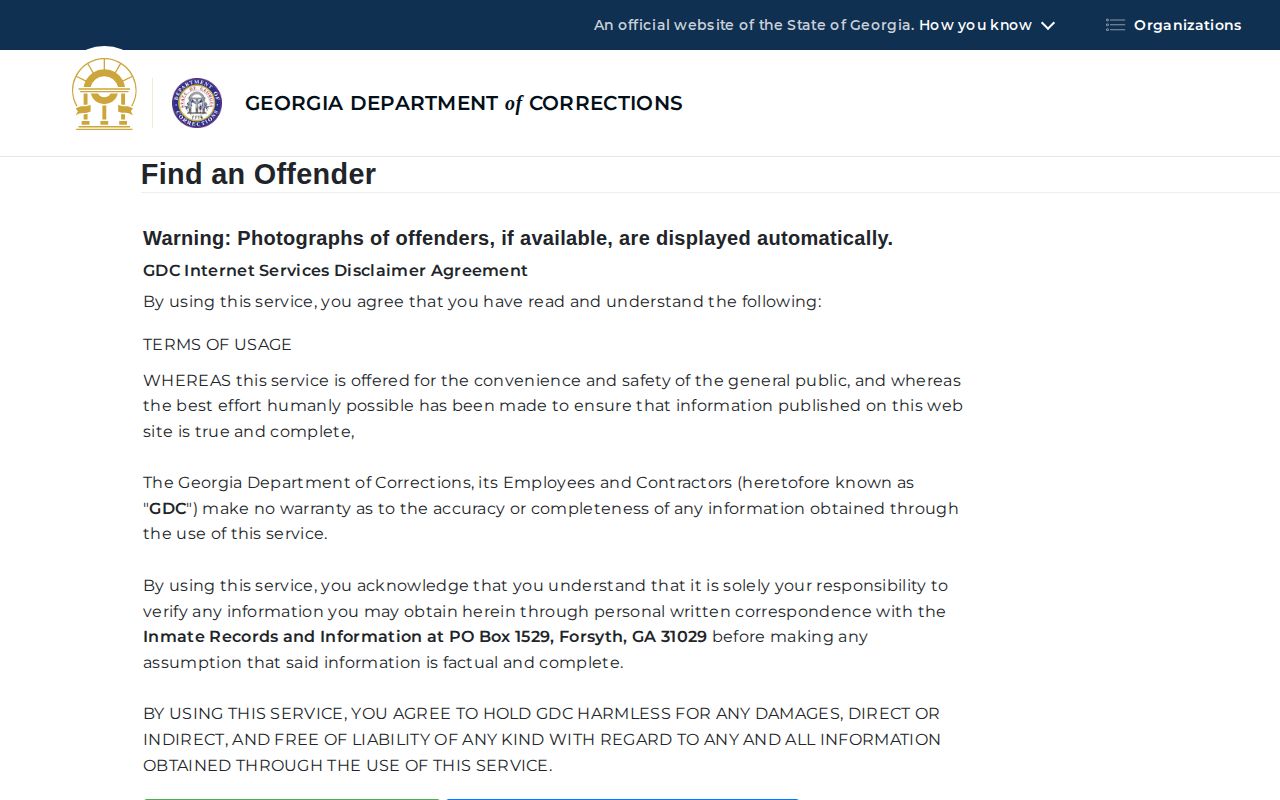
The direct search is most useful when a county release was actually a transfer into state custody or the person later completed a GDC sentence.
Spalding Court Release Records
Court files often outlast jail display records. A docket may show bond, dismissal, a plea, time-served credit, probation, revocation, transfer, sentence modification, nolle prosequi, or final disposition. The Spalding State Court page links online access, and re:SearchGA provides the search platform. An account may be required.
The clerk's listing cautions that staff do not perform record searches. Search first, then contact the clerk with a case number or other specific file detail. The State and Superior Court clerk is at 132 E. Solomon Street in Griffin and lists weekday hours from 8:00 a.m. to 5:00 p.m. Court proof explains why custody ended, while the sheriff record establishes when the jail carried out the release.
A court result also needs careful reading. A bond order authorizes release only after bond requirements and any other holds are cleared. A sentence may award jail credit yet leave another count unresolved. Probation can begin after confinement, while a revocation entry can return a person to custody later. A bench warrant or wanted-list match is a new status, not part of the old release record. Pair the docket event with the sheriff's release time and any next-agency result before drawing a conclusion.
Spalding Supervision After Release
Probation is ordered by a court. Parole is a conditional release from a prison sentence granted by the State Board of Pardons and Paroles. Georgia DCS supervises both felony probationers and parolees in the community. The Board's parolee database verifies parole, while court records and the DCS Griffin field office help confirm probation.
The Spalding County Reentry Program offers a local, purpose-neutral path toward stability, accountability, and renewed purpose after release. It lists 678-603-1090. This is a community resource, not a custody-status source. Formal supervision should still be verified with the Board, DCS, or the sentencing court.
Spalding Release Alerts and Transfers
Georgia VINE can provide custody-change notices for participating agencies. It works best when registration occurs while the person is still in a tracked status. A release alert does not always state whether the person bonded out, finished a term, entered parole, or moved to another custodian, so verify the reason with the originating office.
Federal cases require federal sources. The BOP Inmate Locator covers federal prisoners from 1982 forward and can show a release date or that someone is not in BOP custody. ICE uses its Online Detainee Locator. USMS pretrial custody may occur in a local jail and offers limited public detail, making federal court records and the district Marshals office more useful.
Spalding Jail Detainer Releases
The sheriff's detention immigration report page links quarterly reports tied to Georgia HB 1105. That local reporting layer is important because a county release can send someone to ICE or another detainer authority. It should not be described as release to the community.
When a transfer is suspected, request the release or transfer entry from Spalding County and search the receiving system. An ICE search can use name, country of birth, and birth date or an A-number. A BOP result applies after federal designation, while USMS may control the earlier federal court stage.
Compare Spalding Release Sources
Each system answers a different question. Use more than one when the custody path is unclear.
| Source | Best use | Main limit |
|---|---|---|
| Spalding P2C | Current county jail custody and visible detail | No official recent-release archive |
| Sheriff release record | Date, time, reason, and transfer from county custody | May require a request |
| Spalding court docket | Bond, sentence, dismissal, or probation basis | Does not always show the jail's processing time |
| GDC search | State custody, actual release, sentence history | Not a local pretrial roster |
| VINE | Custody-change alerts | Not the full formal record |
| BOP or ICE | Federal prison or immigration custody | Only applies to the matching federal system |
Spalding County Release Facilities
The county jail holds pretrial, post-trial, probation, City of Griffin, medical-transport, and transfer cases. SCCI is a separate county correctional institution operating under GDC rules. The county says its original work camp began in 1952 and the present site was built in 2001. That history explains why a person linked to “Spalding” may require a GDC search instead of the sheriff roster.
- Spalding County Jail / Detention Center: county custody and sheriff release records.
- City of Griffin detainees: housed at the county jail, with court and sheriff records after release.
- Spalding County Correctional Institution: state inmates verified through GDC.
- Georgia DOC release search: statewide prison and discharge records.
- Federal BOP releases: post-conviction federal custody.
- ICE detainee releases: immigration custody and detainer transfers.
- U.S. Marshals custody: federal pretrial and transport custody.
City of Griffin detainees use the same P2C current-custody route while held at the county detention center. After release, the durable trail may sit in a municipal, State, or Superior Court case rather than a city jail archive. Federal and immigration pages apply only when the facts point to those custodians. Choosing the right facility first prevents a common error: searching the county jail for a state prisoner, or searching BOP for a person whose case never left Georgia courts.
Which record proves community release? No single screen always does. A sheriff entry can show that local custody ended, while a receiving-agency result can show that another hold began. Community release is best supported when the release reason, court disposition, and relevant state or federal searches agree. If they do not, the originating records office can clarify the recorded transfer or release reason.